Check Out Amazon

Showing posts with label tourists. Show all posts

Wednesday, April 29, 2015

Kinamat Resto Bar Silog and Budbod Menu (Angono, Rizal)

"Fi-fi-fo-fum. I smell a hungry customer. Solve this riddle to enter..."

Kinamat Resto Bar in Angono, Rizal is a simple native eatery with a band area for guests to experience a little live music while dining or drinking with friends and family. It has a rustic ambiance with all the natural materials like wood, bamboo, and nipa, used in the building structure. Outside, traditional masks used in festival parades look out to welcome diners. One could easily pass by this restaurant without noticing it. There's just a gravel driveway where guests can park, but apart from the sign hanging from a bamboo post and what's painted on the front wall, one would think that it's not a restaurant at all, but people do frequent the place and word-of-mouth gets around. When kids hear about the shark lamp, they all want to see it with their own eyes, though it's only made of fiberglass, maybe.

Sink your teeth into this crispy Kinamat pork chop.

Kinamat Resto Bar is simple, informal, quaint, and a local favorite, which means tourists have nothing to lose by checking out the place and ordering local food favorites like budbod, which is similar to Spanish tapas but with fried meat that's heartily mixed in with rice and slivers of scrambled egg. There are different kinds of budbod available. There's Shanghai (lumpia or egg roll as it's called by Americans), Pork, Beef, and Mixed, Of course, where there's budbod, there's also likely the silog dishes which are essentially fried rice (sinangag) with ulam, which is the meat you eat with the rice, like fried beef, pork, longanisa, chicken, bangus, hotdog... all served with fried egg, tomatos and your choice of either vinegar (suka) or fish sauce (patis). It's like breakfast at any hour of the day! there's also the popular breaded pork chop that is crunchy on the outside and juicy in the inside. Most of what's in the menu would complement a bottle of cold beer, as the locals would prefer it. But just as the restaurant is simple, so are what's in the menu, but it's all good. Kinamat Resto Bar is located along 1342 Col. Guido St. near the Manila East Rd. Tricycle and jeepney drivers can tell you where it is.

Kinamat Resto Bar's Beef Budbod.

Kinamat Resto Bar's Menu. Click to read.


Sunday, April 12, 2015

Batchoy Noodle Soup Is for Tourists to Taste in The Philippines

American and British tourists should get a taste of batchoy in the Philippines.

One of the noodle soup dishes popular in the Philippines as a merienda meal is batchoy, a noodle soup which includes slivers of braised pork meat with crunchy skin, liver, and shrimp steeped in a salt, pepper and egg noodle broth flavored with sauteed garlic and onions. It's simple but flavorful with a perfect blend of ingredients that tease the taste buds with every sip of the hot broth. It's an oriental in style but distinctly Filipino. Batchoy, is a dish that Western tourists (Americans, British, etc.) should taste and experience because it's unlike the usual noodle dishes from other Asian countries.

Batchoy originated in the Visayas region. According to Wikipedia, it was first made in La Paz in the province of Iloilo by someone named Federico Guillergan, Sr. in 1938. Whether he's the sole originator, it's hard to say, but what did happen was batchoy became Iloilo's signature dish and is now popular all over the country. It's particularly more enjoyable during the rainy season when piping hot batchoy can be a warm companion.

Inside the Eskina batchoy restaurant in the Sta. Lucia mall.

Pictured here are bowls of hot batchoy served at the Eskina Ilonggo Manukan Seafoods at Batchoy restaurant at the Sta. Lucia mall along Marcos Highway in Cainta, Rizal. Since opening, this restaurant has become one of the more popular merienda or mid-afternoon snack establishments to go to when people are craving for a fix of batchoy noodle soup. If you're an American or British tourist, looking to experience Filipino cuisine, don't forget to get a taste of batchoy. This is just one of the restaurants that specializes in batchoy.

Friday, September 24, 2010

Picnic Grove in Tagaytay Is a Fave of Tourists


If you've long been a resident of the Philippines, you already know about the Picnic Grove in Tagaytay. For many of you reading this, it is a place filled with memories of yourself as a child running and rolling on the grassy slopes, basking in the sunshine with cool wind in your face, and immersing yourself in the grand view of Taal Volcano and it's lake. Picnic Grove is indeed, every Filipino's summer destination. in Luzon.

Picnic Grove has gone through a lot of changes through the years, but it's still doing good business with it's horseback riding experience for kids and adults alike. There used to be a lot more open spaces and facilities were better and less crowded way back in the nineteen sixties and seventies, but for the visitors who travel for hours just to get there, it doesn't really matter. They simply know that they are going to have a great time on the grass socializing with friends and family and enjoying a brief respite from the polluted city.

A new treat at the Picnic Grove is the zip and cable car line. If you are brave enough, you can take a ride and zip on a cable across a deep chasm like you're flying through the air! And it's not just one way, but back and forth!

If the zip line isn't for you, you can simply relax and chill out. Tourists can rent covered picnic tables, although during peak days, most will already be occupied if you come in late in the day. The only other option is to rent or purchase one of the picnic mats from the friendly peddlers roaming the facility. Make sure you get a mat that's clean and dry. Watch out for ants where you place them, because you never know where the ants really are unless you look closely!

Can't go to Tagaytay to go horseback riding? Here's something to cheer you up! It's the Haflinger Light Brown Plush Pony! It's soft, it's cuddly, it's cute, and best of all - it's a horse! Click here to order this fine plush pony stuffed toy.

Check out Cheap Visitors if you are into business over the Internet!

Monday, September 20, 2010

Tagaytay Zip Zoo Zip Line Thrills and Amazing Animals


There's a petting zoo in Tagaytay City in the Philippines where tourists can see animals like tigers, crocodiles, birds, monkeys, an alpaca, and many others, from different parts of the world. The place is called Zip Zoo and there's a good reason why. Apart from the animals, its other main attraction is the zip line and cable car. If you don't know what a zip line is, well, it's basically a cable where you slide from one end to another while supported by a harness - much like the kind used in hang gliding. If you ride the Zip Zoo zip line, you get a fantastic view of Taal Volcano (left)!

The Zip Zoo zip line is but one of two in Tagaytay that tourists flock to. Use of the zip line is included in the entrance fee. Tourists get a souvenir photo with a soft-wood frame after the ride, which is really a back and forth package. For one way, you use the harness and zip through the line like superman (below). But customers are given other ride positions to choose from. They can ride in a sitting or upside down position and can even have a kid riding on your back, like you're a horse! On the way back, you ride the cable car (top) and you get to choose between a "normal" easy ride and a "thrill" ride. The latter will give you real heart-throbbing excitement that you will never forget! You can always ask the resident alpaca, it knows!


When riding the harness or the cable car, it is best to keep loose items securely tucked in your pockets. If you wear sandals, the attendants will take care of them and secure them behind your back in the harness. If you plan on taking pictures while riding, make sure you hold on very tightly to your camera or cell phone. It is easy to let go of it while in the middle of the ride. For all it's worth, you get to see your gadget falling to it's doom for several seconds if you do let go of it!

Kamay ni Hesus Healing Center in Lucban, Quezon

Wish you had a friend to ride the zip line with? Well, if your friends are too scared to ride, then you can take Thomas the steam engine with you! He's a train, but he has the heart to zip with you as his friend! Order the Thomas and Friends Zip Zoom and Logging Adventure Playset here and have the time of your life!

Cheap Visitors get you great sales online! Join Cheap Visitors here!

Friday, September 10, 2010

Punta de Fabian Resort in Baras, Rizal Has Great View of Laguna de Bay


Rizal is one big place. It's not exaclty a province separate from Metro Manila, since a big part of it is still well within the urban sprawl of the metropolis, but the fringes are pretty much rural. Lots of resorts are in Rizal and most of them are set either high in the hills or near Laguna Lake (Laguna de Bay). The lake itself is not fit for swimming because it is murky with lots of fish pens. However, the lake does provide a great view (top) and many tourists will find this a good alternative to Tagaytay where Taal lake is viewed.

Shown are portions of Punta de Fabian resort in Baras, Rizal which is a part of Tanay. It is small and is on top of a small and rocky hill. You will need a powerful engine to get to the top since there is a very steep but brief climb after you pass the guardhouse. There are two swimming pools (one small; another an infinity-type) and quaint cottages, most of which have great views. It's ideal for weekend trips with the family and corporate trainings, workshops, seminars, and team-building. The management is courteous and will go out of their way to help out clients with their needs.

The resort has facilities for indoor sports like darts, table tennis, and billiards in the game room. Conference rooms are convenient and spacious and are a short walk to the dining area where clients get treated to packaged European-style meals (below). There is also a videoke bar to release your hidden singing talents. When it rains, it pays to be careful when walking on tiled steps and the mud, both of which can get very slippery.


Giniling (Philippine picadillo) recipe


Thursday, September 9, 2010

Noah's Ark Attracts Tourists in Lucban Quezon


There's a concrete replica of Noah's Ark in Lucban, Quezon, in The Philippines. It's part of the Kamay ni Hesus Healing Center of Father Joey Faller, a Catholic healing priest who found his true calling in life as a servant of God after he discovered that he can heal people of many illnesses. After an accident which caused the last finger of one of his hands to curl permanently, he set out to fulfill his destiny to heal people, and eventually established the Center with a church and Bible-themed park for those in search of healing through God.

The Ark of Noah is just one of the many attractions of the Kamay ni Hesus Healing Center, with the main one being the Grotto with the 50-foot monument of Jesus Christ at the top of a hill. Noah's Ark is really a building with an exterior made to resemble the ancient boat where Noah's family took refuge from the Great Flood along with pairs of animals. At the time these photos were taken, it was still under construction.

The Kamay ni Hesus Healing Center is found in Lucban, Quezon. Those interested can read more about it in this article:

Kamay ni Hesus Healing Church


Have you ever wished you could build your own giant Noah's Ark? You really don't need much! All you have to do is order this Giant Noah's Ark floor jigsaw puzzle. It's cheap!

Sunday, August 15, 2010

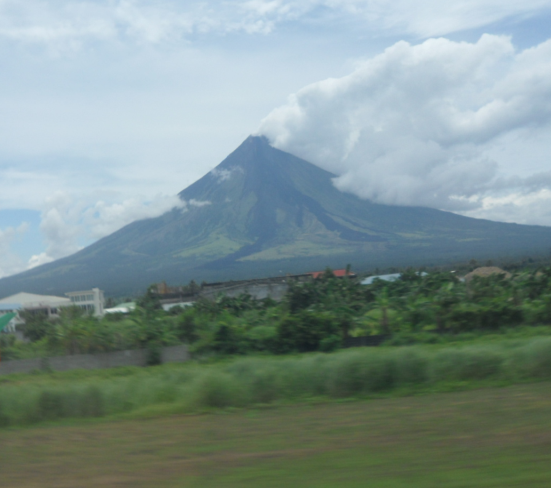
Mayon Volcano Greets Air Travelers to Legaspi City in Bicol


What could be a better greeting for air travelers to the Bicol region in the Philippines than being greeting upon landing in Legaspi City airport, by majestic Mayon Volcano? Yes, locals say the volcano shows it's whole beauty very rarely as it is often shrouded in clouds. Consider yourself lucky to get a glimpse of it's smoking crater as your airplane lands. The name Mayon comes from the local term for beautiful, maayon.

Sometimes, the pilot will fly close to the peak and will announce that you can take a peek out the windows (usually on the left) to get a really close look at the summit of Mayon Volcano. It's active, so you'll be treated to while smoke and gas coming out of its crater. You will also be able to see the blackish lava flow that has hardened coming down the slopes. During eruptions, the crater spews rolling balls of exploding lava and it can be a spectacular sight from the ground! Upon landing, you will be able to see Mayon on the right side, but it will be much farther away (top; left).

Please click on the images for a bigger picture!

Sunday, May 30, 2010

Antipolo Church and Cashew Nuts Sold on the Street


This is the famous Antipolo church in Antipolo city in the Philippines. People from different parts of Metro Manila go here to hear mass, which is why it it almost always crowded on Sundays. Because of the number of people who hear mass, the receiving of holy communion is allowed on the church grounds where lay ministers go around with the Sacramental bread for the faithful to accept. It can be hot, especially in summer, but the trip for Catholic worshipers is worthwhile.

In the street that fronts the church, vendors sell all sorts of sweets and fruits. There are lots of cashew nuts being sold and a few vendors even sell fresh cashew apples. Antipolo is one city in the Philippines where you can find cashew nuts and fruits in abundance and . Elsewhere, you may find cashew nuts (which can be expensive), but rarely cashew apple fruits, which do not sell well.

Cashew Trivia

Unknown to many people, the cashew apple is only a pseudo fruit and is essentially just the enlarged portion of the branch that holds the fruiting organ. It can be eaten raw when ripe. It's fruit acid is highly astringent in the mouth but it is high in Vitamin C. It's not usually used for cooking, but by the taste of it, it may be a good substitute for kamias or kalamias as it is called in some parts of the country. The cashew apple may be turned into a sweet preserve or wine, which is popular in Africa. The cashew apple is rich in tannins which cause it to ripen quickly after picking.

The cashew nut is extracted from the bean-shaped shell (which is really the actual fruit) by burning the fruit in hot coals. Be warned that the oil and fumes from the shell of the nut (not the apple) is toxic and can cause allergies in people. The smoke reportedly readily kills fowl. DO NOT INHALE CASHEW SHELL NUT FUME OR ALLOW IT TO COME IN CONTACT WITH YOUR SKIN. Also, do not touch the oil from the shell because it can cause skin irritation. Wash your hands thoroughly if this happens.

In spit of the toxicity of the oil in the cashew nut shell, the oil from the edible nut itself can be used to treat warts and other skin growths. If you chew some raw cashew nuts and place the resulting poultice on a pesky wart regularly, you will discover that your wart will dry up and fall away eventually. Do exercise caution when chewing, because if you chew for too long, the inside of your mouth may experience the same drying and exfoliating effect of the cashew nut oil. DO NOT MISTAKE THE CASHEW SHELL FOR THE CASHEW NUT (which is inside the shell). THE CASHEW SHELL IS POISONOUS; THE CASHEW NUT, ON THE OTHER HAND IS THE ONE THAT'S EDIBLE.

If having to deal with the toxic cashew shell is too much for you, then you can just use the sap from the cashew apple on your skin. You can slice the cashew apple thinly and use the slices to massage your face with. The juice will serve as a mild astringent to your skin. But again, exercise caution and do not overdo it. Try the sap on a small patch of skin on your arm first for a few days before trying it out on your face. See if you do not have any allergic reactions.

It's a fact that some people are allergic to cashew sap and you could be one of them! Also see if the sap produces discoloration or darkens your skin as a result of its tannins that darken when exposed to air. Generally, the sap should give a mild tightening and exfoliating effect on your skin. But use it at your own risk! It's always better to consult a dermatologist than to experiment with topical things you know nothing about.

  
Nuts, Peanuts and Soy Allergy Translation Card - 
Translated in Tagalog (The Philippines) or any of 67 languages

Thursday, May 6, 2010

Kubo ni Ka Ipe: A Quaint QC Restaurant with a Creeping Plant Growing on the Nipa Ceiling


There is a quaint and small restaurant in or near Teacher's Village in Quezon City. It's called Kainan sa Kubo ni Ka Ipe. It's near Kalayaan Avenue and Malingap Street - 89 Malumanay st., to be exact, and it's interesting because it's got a creeping vine growing on the ceiling (see pictures on the left and below). It's said that the plant just crept inside and started to grow and it's now the main attraction of the eatery. It's got a nipa roof and wooden furniture which gives it an airy and refreshing nayon ambiance, especially with the wind chimes, seashell chandeliers, and big windows. It definitely has a rustic Filipino charm that's adorable.

The Kubo ni Ka Ipe is run by Nida Najera and was borne from her efforts catering food to her tenants. This led to the establishment, and turned space in her residence into something useful. The standard menu has the usual Filipino toppings like the "silogs" (rice meals with egg), but they also have house specialties like the dinuguan. Lunch "turo-turo" meals are also available. The restaurant caters to nearby offices and bilao pancit orders are popular for corporate events. Once you see the vine on the ceiling (left' below), you will really be impressed. Yes, it's the conversation piece on every table and you'll likely look at it more than the History Channel show on the television set in the corner.


If you're in the area, you might want to check out Kainan sa Kubo ni Ka Ipe with your friends, stay for a while and soak in the Filipino eating experience.You might even be able to identify the plant, if you're into botany or agriculture.

Philippine House Lizard Learns to Eat Rice Lightning-Fast

We all know that house lizards eat insects, and house lizards in The Philippines (known as butiki ) are no exception. But there was this...