Check Out Amazon

Showing posts with label Bicol. Show all posts

Sunday, November 25, 2012

Hot Chili Ice Cream in the Philippines

Chili ice cream served at the 1st Colonial Grill
1st Colonial ice cream selections.
With so many ice cream flavors available, would you want to try chili ice cream? Yes, it's one of the strangest ice cream recipes out there and you can find some served at the 1st Colonial Grill in Legazpi City in Albay province in Bicol, Philippines. As a region known for it's chili pepper cuisine, ice cream made from hot chili peppers isn't surprising. Bicolanos are famous for their hot dishes, so if you're looking for ice cream that's really hot, you can find some in Bicol.

Where can you find 1st Colonial Grille? This restaurant famous for its exotic homemade ice cream recipes has several branches in Legazpi City. Just ask around and you'll be directed to one of the branches like the one at the Pacific Mall. Several unique ice cream flavors are available, such as Bailey's (the cream liquor), Kalamansi, Malunggay (Moringa oleifera), Tinutong (burnt rice), Pili (a native nut), Coffee, and Melon, but the most intriguing is the chili, or sili, ice cream, as it's called locally. But there's nothing silly about this homemade ice cream. It's seriously hot on top of its sweetness and creaminess. A spoonful of it will initially naturally feel cold in your mouth, but after several more, you will definitely taste the burning hot chili.

The 1st Colonial chili ice cream flavor is not for everyone, but if you're curious, you will need to have a few ice-cold glasses of water ready. You may give a cold shoulder to this chili ice cream, but this is the hottest homemade ice cream around town. If you'll be visiting Legazpi City any time soon to see Mayon Volcano, make sure you also drop by 1st Colonial Grille to get a taste of its amazing flavors of ice cream. It's cozy, laid back, and has friendly management and staff.

You can make your own ice cream recipe using chili. Just add blended chili into the mix! Learn the basics of making homemade ice cream here.

1st Colonial Grill manager gets friendly with customers.

Sunday, September 16, 2012

Mayon Volcano Viewed from Ligñon Hill


Mayon volcano viewed from Ligñon Hill. Zip line is visible.

Ligñon Hill Promenade.
Ligñon Hill Nature Hill in Legaspi, Albay, Bicol is one of the prominent landmarks, apart from Mayon Volcano, that greet folks who fly into the city. At over 500 feet high, it's prominent enough to be seen from a landing airplane because the runway lies at the foot of the hill. As a tourist attraction, it's strangely not that well known, even to some Bicolanos. Mayon volcano and the Cagsawa ruins take center stage.

Nevertheless, in spite of the better known attractions in Legaspi, Ligñon Hill is really a good place to start your tour of Legaspi. It has an old World War 2 Japanese underground bunker, zip lines, and spectacular views of the countryside from the top which includes beautiful Mayon Volcano, Legaspi City, and Daraga. A restaurant and walkways at the top provide visitors a pleasant environment to soak in the sights. A pair of coin slot outdoor telescopes provide good entertainment to kids and adults alike.


For the more adventurous, tourists can go rappelling or rent a bike or an ATV to explore the lower landscapes of Mayon volcano. For those who are less into taking such sports, they can simply take pictures of the panoramic views. Mornings and nights give especially great sights!

Want your own Mayon volcano in your home? Click here or on the image to order the Star Wars Mustafar Volcano Lab Kit.

Monday, September 10, 2012

Pancit Bato of Camarines Sur

Pancit bato packaged in plastic.

Cooked pancit bato.
Pancit bato translates to "rock noodles," but the name has nothing to do with stones. Pancit bato is actually a type of noodles from the town of Bato in Camarines Sur, where the famous Lake Bato may be found. It is made of flour and heat-dried. It's been said that this is traditionally done under the sun over stones, but the commercial way of doing it is to use oven or furnace heat.

The dry noodles are shaped into blocks and packaged in plastic. It used to be that only the original pancit bato was available in stores, there are now several varieties or flavors offered for sale like Malunggay, Kalabasa (Squash), and Carrot. These make for tasty choices to satisfy different palates who want to taste something different from the usual pancit bihon and canton fare.

Cooking pancit bato is easy as it is also the same way pancit canton is prepared. It also uses the same ingredients and cooked pretty much with the same steps. The noodles are immersed in hot water until soft. They are then drained of water. After that, the vegetables (chopped carrot, cabbage, etc.), chicken liver, and seasonings are added. When cooked, pancit bato is best served and eaten while hot.

Pancit bato factory and store along the highway of Bato town.

Pancit bato can be bought in store-factories along the highway in the town of Bato. Just pull over when you see a store. They're near the turn to Iriga.

How to cook Davao "udong" noodles with meatballs

Sunday, September 9, 2012

Mutant Featherless Chicken in the Philippines

Unique, mutant featherless chicken found in Iriga, Bicol.

Featherless chicken shown off.
Have you ever seen a featherless chicken? Of course we always see them when the chicken is ready to be sold as food, but how about a real live chicken that's practically without feathers? Yes, a bald chicken. KFC new chicken, anyone? Well, there's one found in the province of Iriga in the Bicol region in the Philippines. Except for a few small tufts of down on it's wings, this chicken is categorically naked. It's one of a kind and is the "ugly duckling" of a brood. The other chickens don't seem to like it as they pick on it whenever it gets near them, but then again, most of them are roosters.


Anyway, this featherless chicken just goes about its daily business pecking at the ground in and around a compound. Anybody who sees it would think, "Hey, look. A defeathered chicken's escaped from the pot!" They wouldn't think that the chicken was born that way and that it was not tortured or maltreated in any way. It's come to be a popular mascot in the local neighborhood. The owners didn't have a name for it, so let's let's just name it Mystique, a name inspired by the naked blue lady from The X-Men movies.

The bald chicken of Iriga in Bicol, The Philippines


Can you imagine the possibilities of having featherless chickens around? That would lessen the cost of poultry products as there will no longer be a need to defeather or pluck chickens during processing. They'd be next to ready for the cooking pot. It could be the new chicken at KFC and other chicken restaurants or they can be exotic pets! Scientists have already produced genetically-modified chickens without feathers, but this one is different because it's naturally featherless. Watch this mutant featherless chicken on video.


If you ever need a rubber chicken quickly, then this Emergency Inflatable Rubber Chicken is the answer. Click here to order your own emergency inflatable rubber chicken.

How to Cook Tinuktok; Easy Shrimp Recipe from Bicol, Philippines

Tinuktok (Tinuktuk) as prepared in Iriga, a Bicol province.

This dish is called Tinuktuk in Bicol.
In the Bicol Region in the Philippines, one can expect food to have leaves of the gabi (taro) plant, be spiced with chili, and infused with coconut milk. Tinuktok or tinuktuk, a native food of the region, uses these basic ingredients, which makes it characteristically Bicolano.

Tinuktok is what is known as pinangat in the Tagalog part of Luzon island. Tinuktok may use specific seafood ingredients like shrimp, fish, crab, or even non-seafood meat like beef, pork, and chicken. Shrimp recipes for tinuktok are very popular. Any of these may be used, but they must first be mixed with minced young coconut meat before being wrapped in gabi leaves and cooked in boiling water with coconut milk, called gata in Tagalog. The ideal recipe shrimp tinuktok is usually served spicy, but some people may prefer the non-spicy version.


Ingredients
  • Your choice of shrimp, fish, crab, or a favorite meat (raw; minced)
  • Coconut Milk
  • Gabi (taro) leaves big enough to use as wrapper
  • Minced young coconut meat
  • Salt
  • Pepper corns
  • Fish sauce
  • Red chilli
  • Grass strings for tying
Procedure
Harvest your taro leaves. Ideally, they should be fresh, but if you do not have access to a taro plant, you can buy dried leaves from a Filipino store, which should have them dried. Clean the leaves before you use them. Prepare the easy shrimp recipe to be wrapped inside the taro leaves. Place three spoonfuls in the middle of a leaf. Add fish sauce or salt and pepper to taste. Wrap the taro leaf around the meat patty tightly. Use grass string to tie the preparation before cooking. To help identify the spicy wraps from the non-spicy wraps, tinuktok cooks usually tie the leaves of the spicy ones using two knots. Each shrimp recipe tinuktok should look like a little pillow.


Make as many  of these little pillows as you like. When you have enough, prepare water that's been mixed with coconut milk. The thicker it is (with more coconut milk), the more coconut flavor will be absorbed by the tinuktok. Pour this mixture into a deep pan placed over a low flame or heat source. Put your tinuktok in the water. Make sure they are submerged, but it should only be shallow. Wait until it comes to a boil. Reduce the liquid a bit until the tinuktok dish is done. You can add some color to the tinuktok by adding some chili when you plate. To really enjoy this wonderful recipe shrimp tinuktok (or any of it's seafood, beef, pork, or chicken variants), you must eat it with hot white rice.

Sunday, August 15, 2010

Mayon Volcano Greets Air Travelers to Legaspi City in Bicol


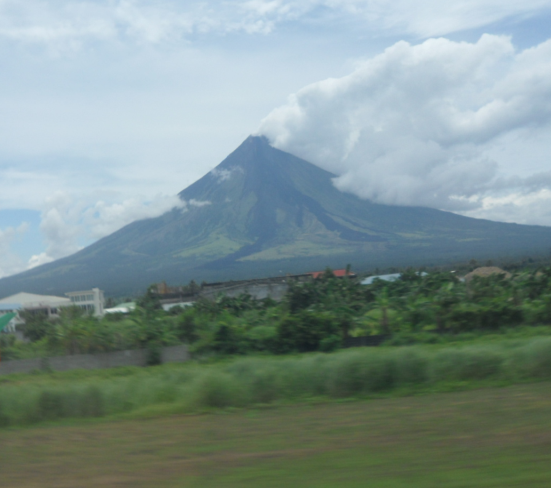
What could be a better greeting for air travelers to the Bicol region in the Philippines than being greeting upon landing in Legaspi City airport, by majestic Mayon Volcano? Yes, locals say the volcano shows it's whole beauty very rarely as it is often shrouded in clouds. Consider yourself lucky to get a glimpse of it's smoking crater as your airplane lands. The name Mayon comes from the local term for beautiful, maayon.

Sometimes, the pilot will fly close to the peak and will announce that you can take a peek out the windows (usually on the left) to get a really close look at the summit of Mayon Volcano. It's active, so you'll be treated to while smoke and gas coming out of its crater. You will also be able to see the blackish lava flow that has hardened coming down the slopes. During eruptions, the crater spews rolling balls of exploding lava and it can be a spectacular sight from the ground! Upon landing, you will be able to see Mayon on the right side, but it will be much farther away (top; left).

Please click on the images for a bigger picture!

Tuesday, July 13, 2010

Cream Dory Fish Farm in CamSur, Philippines

Mr. Galicia of the cream dory fish farm in Pamukid, San Fernando, Bicol.

Are you looking for cream dory fish for sale in the Philippines? Being an archipelago, the Philippines is a country with lots of fish and sea food. But one thing that's not native to it is the Cream Dory (Pangasius) fish, which is related to the catfish. In recent years fish and sea food traders have brought in the Cream Dory fish which is now bred locally in farms like the one in Pamukid, San Fernando, Camarines Sur in Bicol. It's all about Bicol being a perfect place to farm the fish. For many fans of fish in the Philippines, this is good news as the Cream Dory is something of a celebrity with it's exquisite taste that's perfect for many fish recipes. It already becoming as popular as the ubiquitous Tilapia.


The Cream Dory, a freshwater fish, used to flourish in the Mekong river in Vietnam. Because this river is polluted, it's been wrongly given the reputation as a toxic fish. But really, it's not the fish that's dirty - it's the water. So enterprising people did something that sent the Cream Dory to an all time high in the popularity level. They farmed the fish. Now, Cream Dory fish is being served as part of expensive dishes in countries like the Philippines.

Farmers are taking notice and they see a big sea food trading market opening up as the Cream Dory become better known to Filipinos (although it's a freshwater fish). Already it's being sold at SM supermarkets and restaurant chains. With Cream Dory fish farms being established in the Philippines like this one in and about Bicol (just beside the highway near the giant sardine can billboard in Pamukid), the Cream Dory fish and sea food traders will likely find new food outlets to supply. As prices go down, more Filipinos will be enjoying this delicious fish as a dinner table staple. Cream Dory fish is best served steamed with light soy sauce and leeks.


Wednesday, June 23, 2010

Emerald Grotto of Our Lady of Lourdes in Iriga, Camarines Sur, Bicol Offers Panoramic View


In Iriga, in Camarines Sur in the Bicol region in the Philippines, there's a hill called Calvario. It is where the Emerald Grotto of Our Lady of Lourdes in Iriga can be found. During the Tinagba festival held in February, the first harvests of the season are offered here. In Lent, a crucifixion play is held here.

There is a convention center at the foot of the grotto and a hotel. You can go to the top of the grotto after severl flights of stairs. At the top is an altar, which reminds you of the altar of a church. The statue of the Virgin Mary is to the right, set in the concrete wall. Below the altar is where tourists and locals usually congregate to socialize and to experience the grand view of Mt. Iriga and a few distant mountains, including the famous Mt. Mayon in Legaspi City.

The grotto is accessible through two big gates. If the one beside the hotel is closed, visitors will have to go around to enter from the other side. A guard goes around every once in a while, but the security usually cannot keep up with the activities of people going up to the altar, where debris accumulates. Near dusk,  the lights are switched on which allows the grotto to be a visible emerald gem from a distance.

Tuesday, June 22, 2010

Tricycles Overloaded with Passengers in Bicol, The Philippines


Cars are a luxury in the Philippines. If you don't have a car, you have the option of using public transportation like tricycles. Tricycles are supposed to serve only three passengers at one time, but because of the inadequate number of tricycles in certain areas, there's often the need for people to make the most of things. For tricycle drivers, it's loading more people than what their rig normally carry.

The practice of overloading tricycles isn't really advisable, but it's what's done in provinces like Bicol, where you will often see tricycles filled to the roof! This earns more income for the operator and in a way serves more people. The problem is that it's dangerous. Passengers can get snagged by all manner of things that hang over the road. Powerlines that dip low over the road can be a real danger, especially at night.

Saturday, June 19, 2010

Biggs Restaurants in Bicol Feature Collectible Wall Exhibits


If you're looking for a fastfood chain in Bicol, then you won't miss Biggs. Biggs is just one of the most prominent restaurants/diners in Bicol where you can get the usual diner meals like chicken and rice, spaghetti, burgers, and delicious pastries. Bigss is everywhere in Bicol with branches from north to south. Eating at Biggs is an interesting experience because of it's quaint mid-20th-century-inspired interiors with antique collectibles displayed on the walls.

The branches provide a different experience for diners with the different pieces on display. A branch can be like a museum of modern artifacts. Shown below displayed on a second floor of a diner are miniature motorcyles. These can be found in the branch in Legaspi city near the airport. The signs on the walls (top; above-left) are also interesting to look at and are reminiscent of rock and roll designs from the nineteen fifties. The diner appears designed to cater to a young and hip crowd, but it's also popular to the oldies - maybe it reminds them of the old days.


Philippine House Lizard Learns to Eat Rice Lightning-Fast

We all know that house lizards eat insects, and house lizards in The Philippines (known as butiki ) are no exception. But there was this...